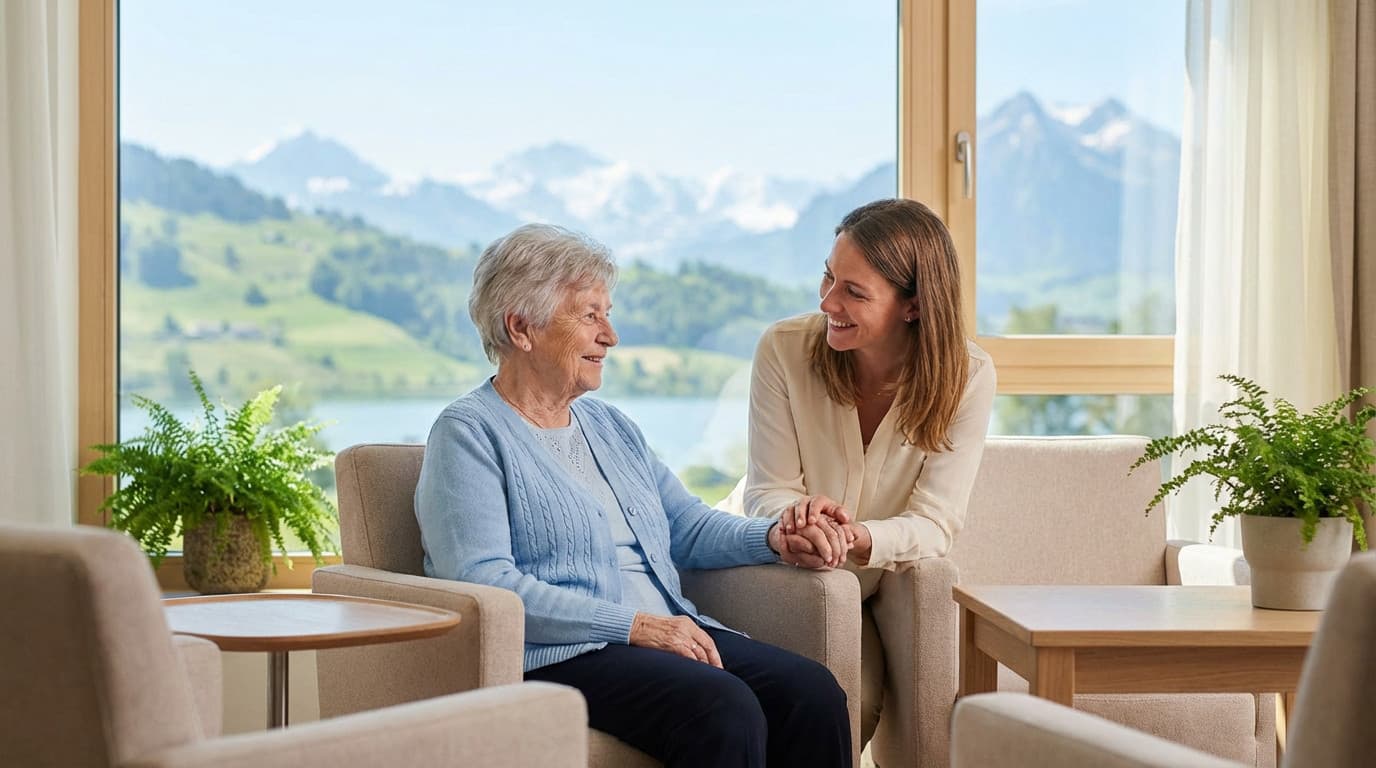
Nursing Homes in Switzerland: How They Work, Costs and Alternatives
Key takeaway: nursing homes are medicalised facilities whose high costs often require supplementary benefits. Understanding this complex funding system and the cantonal disparities helps plan ahead, while also considering the rise of shared living arrangements – an alternative that prioritises autonomy and dignity over the traditional institutional model.
When faced with a loss of independence, finding a suitable place in a Swiss nursing home and covering the financial burden is often a major source of worry for families. This content details how residential care facilities work, the admission criteria and the precise funding mechanisms. Beyond administrative matters, the analysis presents emerging alternative models that prioritise maintaining social connections and residents’ dignity.
- Nursing homes in Switzerland – what are they really?
- The key issue: how to finance a nursing home place?
- Beyond nursing homes: alternatives for ageing differently
Nursing homes in Switzerland – what are they really?
The basics: definition and services offered
A nursing home (known as EMS – Établissement Médico-Social – in Switzerland) goes far beyond the simple concept of housing for retirees. It is first and foremost a medicalised living environment, specifically designed for elderly people with care needs who require constant safety.
However, reducing these facilities to care alone would be a misjudgement. The services cover all daily needs to ensure a dignified quality of life. Here are the pillars of this care provision:
- Accommodation and catering (the « hotel base »).
- Nursing care and daily assistance (the « medical core »).
- Social support and activities to maintain social connections.

Admission process and cantonal disparities
Entering an institution requires a methodical approach and forward planning. The process begins with a medical assessment, placement on a waiting list and coordination with the healthcare network, which is often overstretched.
However, a financial pitfall awaits poorly informed families: cantonal differences. Rates and subsidies vary dramatically depending on location – the canton of Vaud, for example, applies its own fee scales.
The key issue: how to finance a nursing home place?
Having looked at how nursing homes work, let us now address the crucial question of costs.
Breaking down the bill: who pays what?
The bill is divided into three areas: accommodation, care (partly covered by compulsory health insurance) and support services. Here is the breakdown:
| Type of cost | Description | Who pays? |
|---|---|---|
| Board (hotel services) | Accommodation, meals, cleaning | The resident (and/or supplementary benefits) |
| Care | Nursing services, help with personal hygiene | Health insurance (KVG/LAMal) & resident |
| Support & activities | Recreational activities, social support | The resident (and/or supplementary benefits) |
Financial assistance and family responsibility
Supplementary benefits (PC/EL) are vital. Be warned: voluntarily transferred assets are still counted in the calculation, as if you still owned them.
Since 2021, heirs may be required to repay the supplementary benefits received. However, this repayment only applies if the estate exceeds a certain threshold.
Beyond nursing homes: alternatives for ageing differently
Shared living – a more humane model
Shared living arrangements are a concrete alternative to nursing homes. These are small living units where seniors live together. Professionals assist them on a daily basis.
This model places dignity and autonomy back at the centre, away from the constraints of traditional institutions:
- A homely, non-institutional living environment.
- Maintaining social connections to combat isolation.
- Personalised support that respects each individual’s pace.
La Maison du Soleil – a concrete example
Projects such as La Maison du Soleil perfectly embody this new vision. It is a tangible example.
These initiatives are driven by committed stakeholders. Foundations such as the Fondation Caliel are working to create affordable living spaces. They build respectful environments. The goal is a better quality of life.
While nursing homes remain the benchmark in Switzerland for medicalised care, their costs and procedures require careful forward planning. The emergence of alternatives such as shared living arrangements nevertheless opens up new perspectives. These models, focused on dignity and social connections, now make it possible to view ageing from a more humane perspective.
FAQ
What is a nursing home (EMS) in Switzerland?
A nursing home (Établissement Médico-Social, EMS) is a medicalised residential facility for people, generally of OASI retirement age, whose loss of independence no longer allows them to remain at home. Unlike simple accommodation, the nursing home provides comprehensive care that includes socio-hotel services (accommodation, catering, laundry), daily nursing care and social support through various activities.
What are EHPAD called in Switzerland?
In Switzerland, the equivalent of EHPAD […] is called EMS (Établissements Médico-Sociaux), or nursing homes (Pflegeheime in German-speaking Switzerland). Although the terminology differs, these institutions serve the same purpose: accommodating seniors who need care and supervision that intermediate facilities or the home can no longer provide.
How much does a nursing home cost in Switzerland?
The total monthly cost of a nursing home stay generally ranges between CHF 6,000 and CHF 7,000. This amount includes the contribution to accommodation and food costs, the resident’s share of care costs, as well as personal expenses and health insurance premiums. It should be noted that surcharges may apply for comfort services, such as occupying a specific single room.
How are nursing home fees calculated?
The nursing home bill is divided into three cost categories. Firstly, socio-hotel costs (board) are entirely borne by the resident. Secondly, care costs are covered by a daily allowance from compulsory health insurance (KVG/LAMal), although the resident must pay a contribution (set at CHF 23 per day in 2025). Finally, costs for support services and activities are added on top.
Who has to pay for nursing homes in Switzerland?
Funding is primarily provided by the resident through their income (OASI/DI pensions, occupational pension) and their assets. If these resources are insufficient to cover the costs, federal Supplementary Benefits (PC/EL) can be applied for, which are a legal entitlement. In certain cantons such as Vaud, specific assistance schemes (LAPRAMS) may supplement this system. In practice, around 8 out of 10 residents receive social assistance to cover their bills.
Do children have to pay for their parents’ nursing home?
The Swiss system relies on funding through the resident’s income and state assistance (Supplementary Benefits). However, a repayment obligation exists upon inheritance: the supplementary benefits legally received by the deceased must be repaid by the heirs, but only on the portion of the estate exceeding CHF 40,000. Children therefore do not directly pay the monthly costs, but the inheritance may be affected.